AI Agents and UX Design: Mastering the Next Digital Frontier
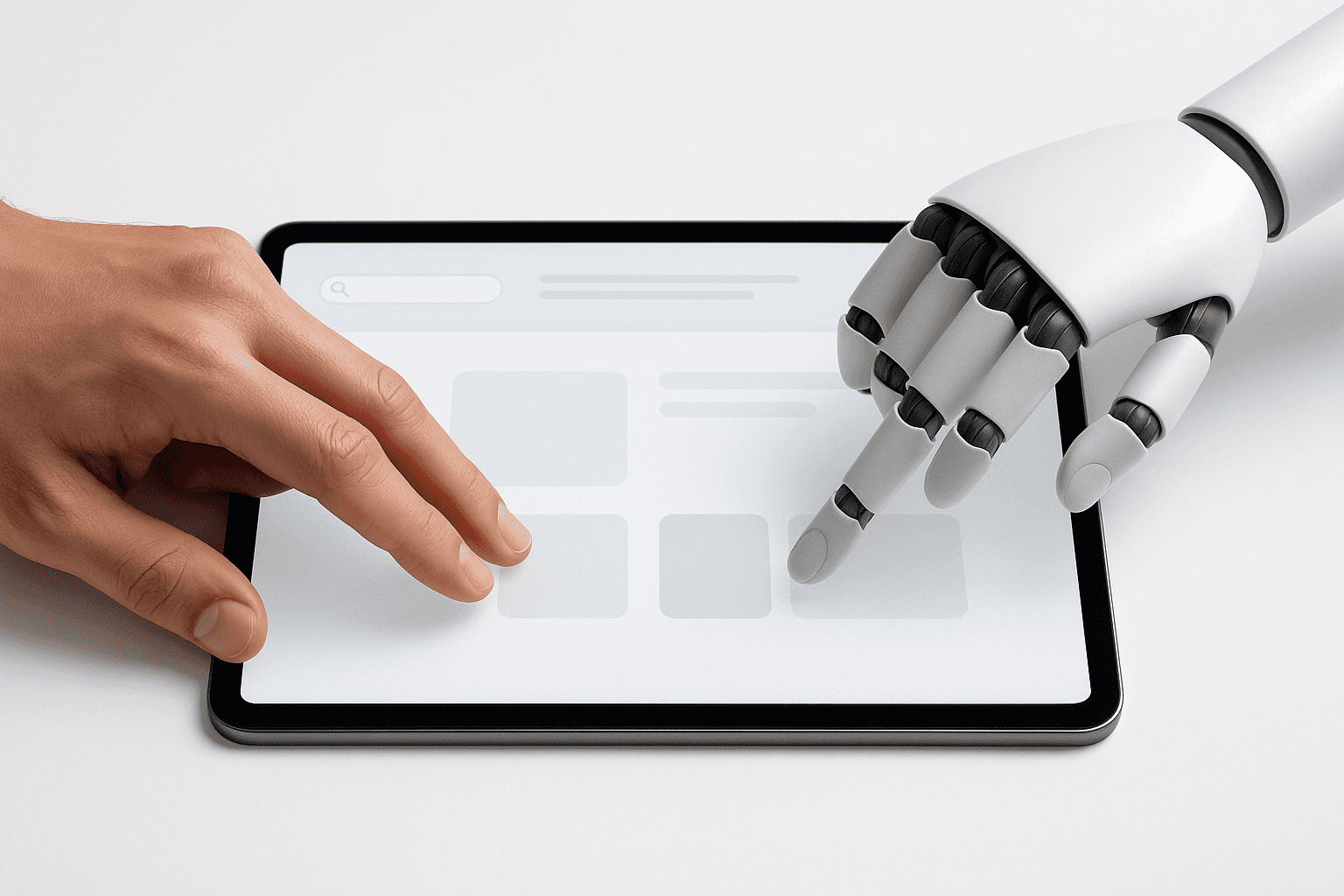
Traditional UX design is grounded in human perception. You focus on layout, visual hierarchy, touch targets, and cognitive load. This approach assumes the end-user is human, interpreting the interface with context and intuition.
AI agents operate on a completely different layer. They do not see your rounded corners, color palettes, or shadows. They consume raw structure, markup, and data relationships. They move through your product by following logic, labels, and patterns you might not even realize are there.
When your interface is not agent-aware, several things can happen:
An AI agent might miss key actions hidden behind decorative or non-standard controls.
It could misinterpret vague labels or incorrectly structured data.
It may trigger unintended workflows, surface outdated content, or expose sensitive information.
If this happens often enough, you are not just dealing with a poor UX. You are dealing with operational and reputational risk.
The Risks of Ignoring Agent-Aware Design
Many teams assume AI agents will simply adapt to whatever interface they encounter. That assumption is dangerous.
Consider a booking platform where an AI agent is tasked with reserving a meeting room. If your availability calendar is built with unlabeled elements, the agent might read the wrong date or confirm a booking in the wrong location.
Or think about a knowledge base with layered menus and dynamic content. An agent without clear structural cues could skip critical instructions entirely. Now multiply that by thousands of automated interactions per day, and the business cost becomes obvious.
The risks are not hypothetical. In agent-driven systems, a misread instruction can lead to incorrect purchases, contract errors, security breaches, or even compliance violations.
Core UX Principles for the Agentic Era
Designing for AI agents requires a shift in priorities. It is no longer enough to optimize for the human eye alone. Here are the foundational principles for building products that serve both audiences effectively.
1. Semantic Structure is Non-Negotiable
Use clean, semantic markup that clearly describes the role and purpose of each element. AI agents parse structure first, not visual styling. Every button, link, and section should be programmatically identifiable.
2. Transparent Navigation
Navigation should be explicit, logical, and easy to parse. Avoid burying critical features behind hidden menus or non-standard gestures. If a human needs multiple clicks to find something, an agent may miss it entirely.
3. Context Through Metadata
Metadata is not decoration. It is a guidepost for machine understanding. Use descriptive labels, ARIA attributes, and structured data so agents can understand context without inference.
4. Predictable Interaction Models
Agents rely on predictable patterns. If your product uses inconsistent button placement, varying field names, or irregular flows, an agent will struggle to execute reliably.
5. Agent Testing as a Standard Practice
Do not just test with human users. Run simulations where AI agents perform the core tasks. Study how they navigate, what they skip, and where they fail. This is as important as cross-browser testing.
The Future is Dual-User Design
This shift is not a passing trend. In the coming years, AI agents will handle more transactional and decision-making work inside your products than human users do. This will include purchasing, scheduling, data entry, research, and complex multi-step workflows.
Your design process needs to embrace this duality:
Interfaces must be intuitive for humans while structured and machine-readable for agents.
Content must be visually appealing yet logically ordered for parsing.
Features must anticipate both direct clicks and indirect, automated triggers.
The bottom line: In the agentic era, the winning products will not just look good. They will be architected for interoperability between human intuition and machine logic. Design teams that ignore this will see adoption, accuracy, and trust erode over time. Teams that embrace it will set the new benchmark for how humans and AI collaborate in digital environments.